
 Español
 Portugues
 Pусский
 العربية
Hot-Dip Galvanized Cable Tray Production
Hot-Dip Galvanized Cable Tray Production Hot-dip galvanized cable trays are widely used in electrical and data communication installations due to their superior corrosion resistance, durability, and cost-effectiveness. The production process involves several key stages, ensuring high-quality performance in harsh environments. 1. Material Selection The process begins with selecting high-quality steel coils or sheets, typically made from low-carbon steel. The material must meet industry standards for strength and flexibility to ensure the cable tray can support heavy loads while maintaining structural integrity. 2. Forming and Fabrication The steel is cut, shaped, and formed into cable tray components using automated machinery. Common types include ladder-type, solid-bottom, and wire-mesh trays. Precision punching, bending, and welding are performed to create the required dimensions and configurations. 3. Surface Preparation Before galvanizing, the steel must be thoroughly cleaned to remove oils, rust, and mill scale. This involves degreasing, acid pickling (using hydrochloric or sulfuric acid), and rinsing to ensure optimal zinc adhesion. 4. Hot-Dip Galvanizing The cleaned steel components are immersed in a molten zinc bath (around 450°C). The zinc bonds metallurgically with the steel, forming a protective zinc-iron alloy layer. This process provides excellent corrosion resistance, even in humid, industrial, or coastal environments. 5. Cooling and Inspection After galvanizing, the trays are cooled and inspected for uniformity, thickness (typically 50-85 microns), and coating quality. Any imperfections are corrected to meet industry standards such as ASTM A123 or ISO 1461. 6. Assembly and Packaging The galvanized components are assembled into complete cable trays, including brackets, connectors, and accessories. They are then packed securely to prevent damage during transportation. Advantages of Hot-Dip Galvanized Cable Trays - Longevity: Resistant to rust and corrosion, extending service life. - Low Maintenance: Requires minimal upkeep compared to painted or stainless steel alternatives. - Cost-Effective: Provides long-term savings due to reduced replacement and maintenance costs. - Versatility: Suitable for indoor and outdoor applications, including industrial plants, data centers, and utility installations. In conclusion, hot-dip galvanized cable tray production involves precise engineering and high-quality galvanizing to ensure reliability and durability in demanding applications. The process guarantees a robust, corrosion-resistant solution for efficient cable management.
Products
Category:
-
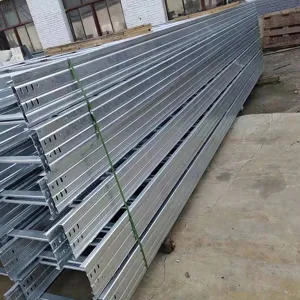
Hot-Dip Galvanized Cable Tray Production
Category: Hot-Dip Galvanized (HDG) Cable TrayBrowse number: 35Number:Release time: 2025-11-24 00:03:01Hot-Dip Galvanizing & Electro-Galvanizing for Cable Trays Hot-Dip Galvanizing (HDG) Zinc exhibits excellent corrosion resistance under atmospheric conditions. Galvanizing is a cathodic protection method for polar metals, where zinc acts as a sacrificial anode. Its corrosion resistance lifespan depends on the zinc coating thickness and corrosion rate. The zinc layer thickness of hot-dip galvanizing is generally above 65 μm (455 g/m²). A zinc-iron alloy layer forms at the interface between zinc and iron, enhancing the adhesion of the zinc coating. Atmospheric exposure tests on hot-dip galvanized layers under various environmental conditions have been conducted overseas. Test results indicate that hot-dip galvanizing can meet the service life requirements of steel cable trays.
News
Category:
No search results found!
Case
Category:
No search results found!
Video
Category:
No search results found!
Download
Category:
No search results found!
Job
Category:
No search results found!
Featured Products
No search results found!



 WhatsApp
 Phone
Phone E-mail